-

1
A New Quantum Era is Emerging
100 years ago scientists discovered that nature behaves differently at extremely small scales.
This insight - quantum mechanics - enabled technologies that power the digital economy:
- Computer chips
- Lasers and fibre optics
- GPS navigation
- MRI medical imaging
This era is known as Quantum 1.0.
Today a new phase is emerging: Quantum 2.0. -

2
The Spooky Fundamentals
Two unusual effects behind quantum technologies
Superposition
Quantum system can exist in a combination of states simultaneously, allowing many possibilities to be explored in parallel, until it is measured.
Entanglement
Quantum systems can become strongly connected, so that measuring one gives information about the others, even when they are far apart.
-
3
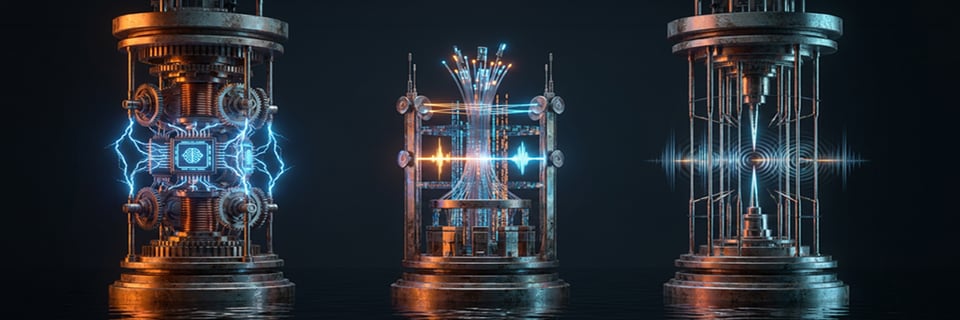
The Three Pillars of Quantum 2.0
Three technologies are shaping the quantum future.
Quantum Computing
Solving certain complex problems dramatically faster.
Quantum Communication
Ultra-secure networks protected by the laws of physics.
Quantum Sensing
Seeing and navigating the unseen with ultra-sensitive quantum sensors.
Together they are driving a global race toward quantum advantage.
-

4
Quantum Computing
The machine that explores every path.
Some problems become exponentially complex as they grow.
Examples include:
- Logistics networks
- Financial market simulations
- Portfolio optimisation
A classical computer explores one path at a time. A quantum computer (using superposition and entanglement) can encode many possible paths in a single quantum state and evaluate them in parallel. This capability can revolutionise problem optimisation and simulation across industries.
-
5
The Engineering Challenge
Quantum information is extremely fragile.
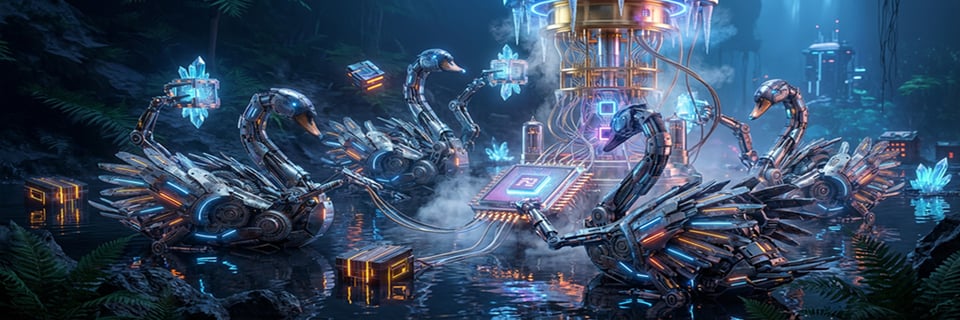
Heat, vibration and electromagnetic noise can disrupt quantum states – a challenge known as decoherence.
Quantum computers therefore require highly controlled environments.
Different technologies are being explored, including:
- Superconducting qubits
- Trapped ions
- Photonic systems
The technology is advancing rapidly, but still evolving.
-

6
The invisible threat
Quantum and Cybersecurity
Many digital systems rely on encryption that classical computers cannot easily break.
However, powerful quantum computers could eventually solve the mathematical problems protecting today's encryption.
Harvest now, decrypt later
Encrypted data intercepted today could be stored and decrypted once quantum computers become powerful enough.
This risk is driving the transition to post-quantum cryptography.
-
7
Quantum Communication
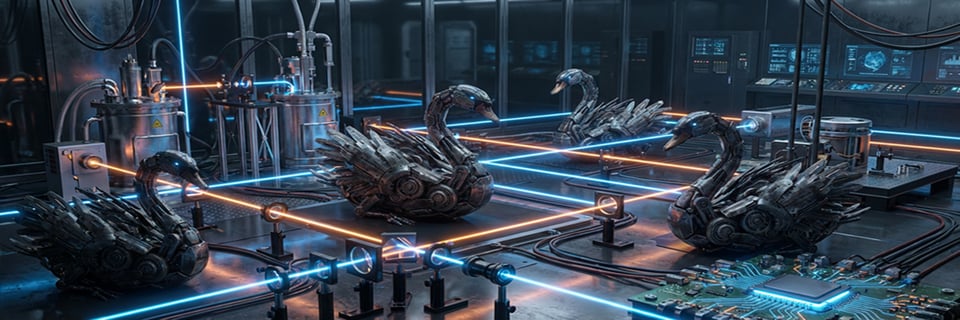
Quantum key distribution (QKD)
Enables encryption keys to be shared using quantum signals.
If a signal is intercepted, the quantum state changes – immediately revealing the intrusion.
This technology could enable ultra-secure networks for financial systems, governments and critical infrastructure.
-
8
Quantum Sensing
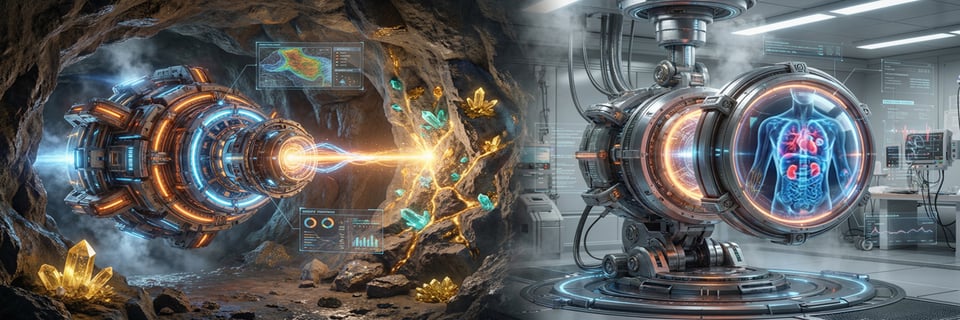
Quantum sensing uses quantum systems to measure extremely small physical signals.
Applications include:
- GPS-independent navigation
- Discovery of underground resources
- Early disease detection
- Monitoring critical infrastructure
Some quantum sensing technologies are already being deployed today.
-

9
The Moment for Finance
When quantum meets the financial system
Finance is built on computation, trust and cryptography. Quantum technologies could reshape all three.
Digital infrastructure at risk
Future quantum computers could break encryption protecting:
- Online banking
- Payment networks
- SWIFT messaging
- Digital identity systems
New computational capabilities
Quantum computing and algorithms could also help with:
- Portfolio optimisation Finding optimal asset allocation across thousands of assets.
- Large-scale risk simulation Running millions of market scenarios simultaneously.
- Fraud detection Identifying hidden patterns across massive datasets.
- Derivatives pricing Solving complex models more efficiently.
For finance, quantum represents both disruption and opportunity.
-

10
Enter Quantum Finance
As quantum technologies advance, leading financial institutions are asking:
- Where will quantum matter most?
- How should institutions prepare?
To explore these questions, the Global Finance & Technology Network (GFTN) launched:
Q-Finex
(Quantum Finance Industry Experimentation) Q-FINEX is a pioneering dedicated quantum-finance testbed connecting the financial industry with quantum research.
In collaboration with the University of Western Australia, the initiative enables:
- Experimentation with real financial use cases
- Collaboration between industry and researchers
- Testing quantum-ready financial models
Why it matters
It is a practical testbed for translating quantum research into real financial use-cases before the technology reaches scale.